SAMPLE LETTER
Brigid's first letter, October 1847.
This is the letter that begins everything. It is October 1847, the worst autumn of the Great Hunger. Three weeks earlier, Brigid O'Donnell held an American wake for her son Seán, the send-off given the night before an emigrant sailed, a gathering with music and dancing and open grief, because the crossing was almost always a parting for good. Seán is somewhere on the Atlantic now, or landed, or lost. His mother does not know which. So she writes.
Read it slowly. This is the register every letter in the series is written in.
This is the Mayo edition, the first county edition and the sample shown here. Every county has its own edition, with its own family living the same eight Books of years.
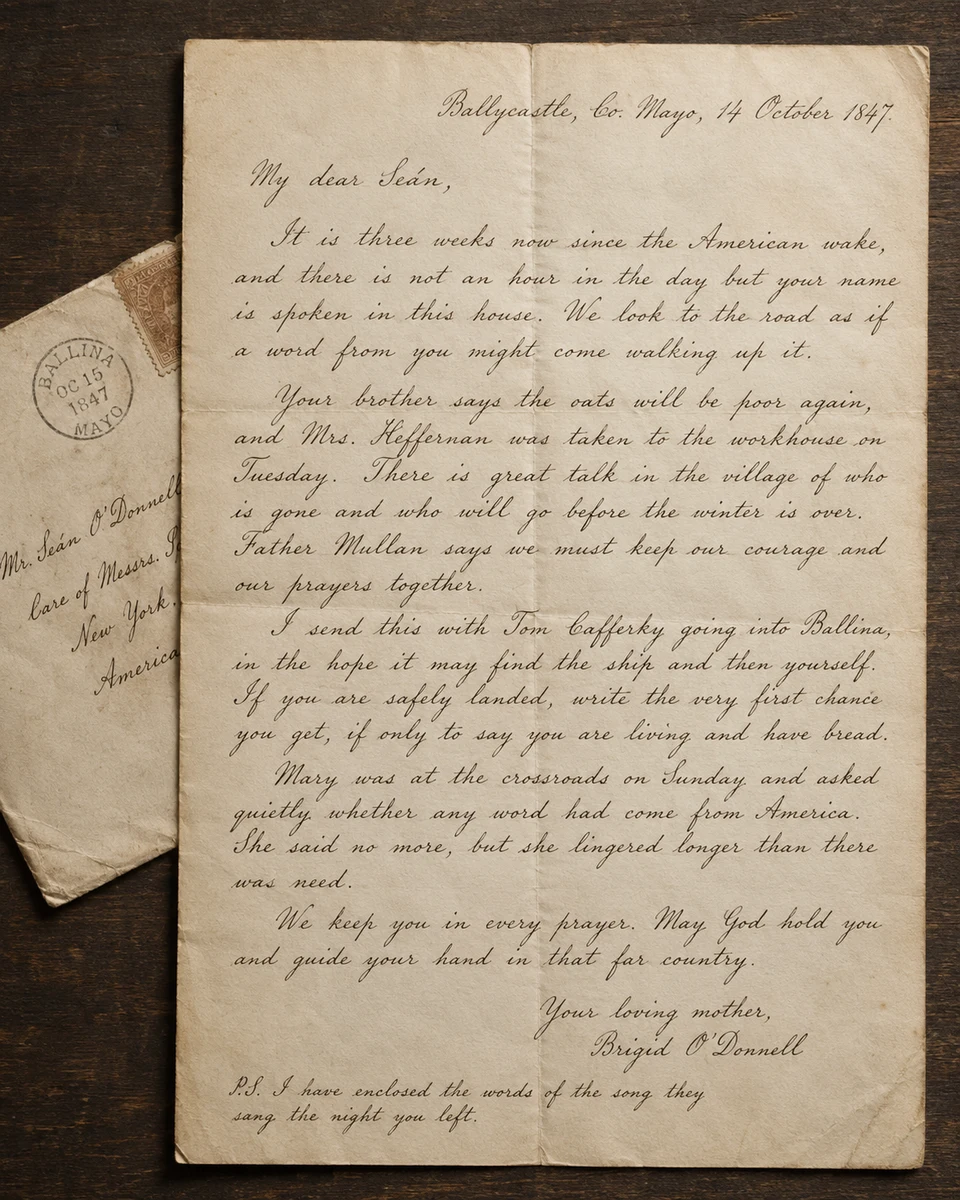
The letter
Ballycastle, Co. Mayo, 14 October 1847.
My dear Seán,
It is three weeks now since the American wake, and there is not an hour in the day but your name is spoken in this house. We look to the road as if a word from you might come walking up it.
Your brother says the oats will be poor again, and Mrs. Heffernan was taken to the workhouse on Tuesday. There is great talk in the village of who is gone and who will go before the winter is over. Father Mullan says we must keep our courage and our prayers together.
I send this with Tom Cafferky going into Ballina, in the hope it may find the ship and then yourself. If you are safely landed, write the very first chance you get, if only to say you are living and have bread.
Mary was at the crossroads on Sunday and asked quietly whether any word had come from America. She said no more, but she lingered longer than there was need.
We keep you in every prayer. May God hold you and guide your hand in that far country.
Your loving mother,
Brigid O'Donnell
P.S. I have enclosed the words of the song they sang the night you left.
What the letter carries
Everything in it is true to the year. The workhouse at Ballina, filling past its doors. The oats failing a third time. A letter sent not by post but with a neighbour going into town, in the hope it might reach a ship. And Mary at the crossroads, asking after word from America and saying no more, a whole unspoken story held in a single restrained line.
That is the promise of the series. The history is real and the feeling is real, and neither is ever overdone. This letter opens Book One: Famine and Farewell.
What arrives in the envelope
A letter you can hold, not a screen you scroll.
- Aged paper, written by hand, in a script sized to be read by older eyes.
- A wax seal, and an envelope hand-addressed to the reader.
- A real Irish postmark, postmarked in Ireland and posted to you, wherever you are.
- A plain-language note enclosed, setting the scene for the month's letter and explaining anything unfamiliar, so nothing is lost.
And nothing else. No trinkets, no filler, no window envelope. Paper only, on purpose: it keeps the mailing a true personal letter, and it means a letter posted to the United States arrives without a customs charge at the door. The envelope itself is the thing that makes someone stop and sit down.
One honest note on authenticity
The people who love these letters know Ireland, and we write for them. Ireland used British stamps, the Penny Black and the Penny Red, until it issued its own in 1922. So a Famine-era letter never carries an Irish stamp that did not exist. Any period stamp shown is British Victorian, honestly labelled, and kept inside the envelope. The postmark that carries it to you today, of course, is a real Irish one.
Join the founding readers
Checkout opens soon. Leave your email and we will hold your place for Book One. You will be first to order when it opens.
Thank you. Your place is held. We will be in touch.
Give the letters as a gift · Common questions · All eight Books